
The Turning House
Short Story. "I went south, to Patagonia, far from everything."

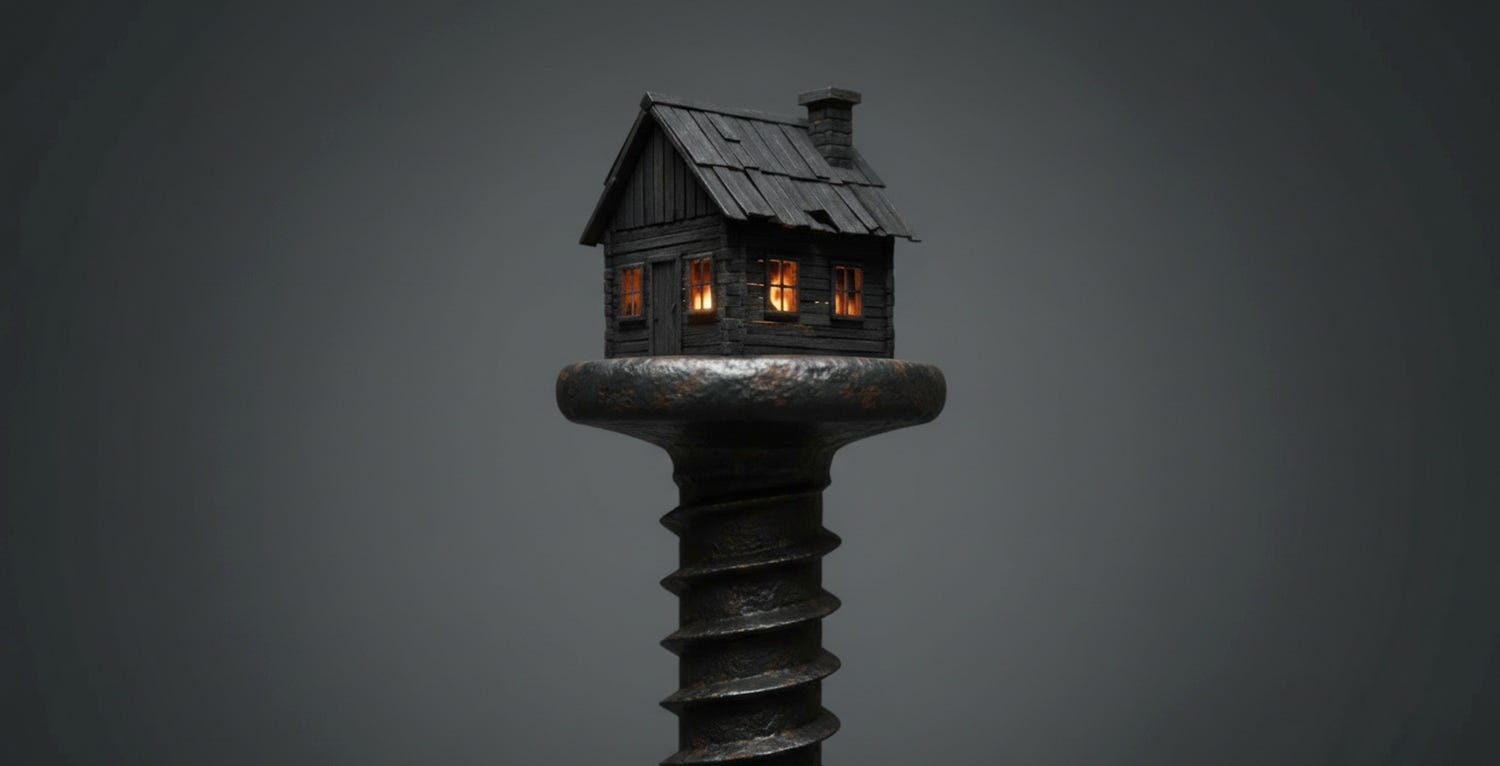
In the city, I could no longer make the dining room my own. My wife had designed it. She was an architect and designed interiors for a chain of coffee shops. In the end, I folded the extendable table until it became a small square one and placed it in the bedroom, next to the bed. I ate dinner there.
Every night, I drank half a bottle of Fernet or rum, a bottle of wine, several cans of beer. The quetiapine, prescribed for my depression and post-traumatic stress disorder, kept the alcohol from hitting me: the next day I woke up as if I hadn’t drunk a thing. And it produced vivid dreams.
I almost always dreamed of my daughter and my wife in the car, singing, until a pickup truck veered into their lane. The car took a slight impact and began to spin and spin, in slow motion, until a stronger impact shattered the windows. At that moment, the dream cut off.
They died on the way to the coast while I was in Brazil, at a book fair I’d been invited to. I had chosen to be there instead of spending the vacation with my family. I needed a bigger publisher, more translations. I let life carry me toward wherever I glimpsed success, without asking myself too many questions when something sounded promising for my career. The questions arrived with the death of my wife and daughter. All at once. It was to silence those questions that I drank every night while watching movies recommended by specialized websites.
I never considered myself an alcoholic. As I said, because of the pills, I slept a lot and woke up refreshed, even after drinking all night. In the afternoon, I cleaned the apartment and did a hundred push-ups. Then I went out with a backpack to buy alcohol at the Chinese supermarket. One day I realized that, in that apartment and with that routine, I would go on like that for the rest of my life. That’s why I had to get out.
I went south, to Patagonia, far from everything. I chose a cabin in a forest clearing near Trevelin. On the roof was an iron weather vane with the compass rose, topped by a fish. It pointed southwest. The vane was the first thing I looked at when I went to see it. The property came with a blueberry plantation, sheltered from the wind by a fence of dead ñire trees.
The previous owner had been an old alcoholic. At the real estate agency, they didn’t tell me he had hanged himself from the lower branches of the tallest pine. Soon enough, people in town did. It didn’t matter to me. I didn’t believe in ghosts. On the contrary, back then I would stare into the darkness until my eyes hurt, waiting for someone or something to appear.
In the south, I did nothing. I barely wrote. I thought I would tend the blueberries, but I didn’t even do that. I let them grow wild. I gathered them in December, filling my cap, tearing the fruit off brutally, without the care needed for harvesting. To avoid damaging the protective waxy bloom, you’re supposed to twist them gently. But I was like a goblin among the bushes; I yanked them and ate them at home as a snack, or, once frozen, I crunched them between my teeth at night to kill the anxiety.
By day, arms crossed in front of the house, I would stand watching the sunlight filter through the crowns of the coihue trees lining the main path, while the air smelled of damp earth and woodsmoke from some distant chimney. At dusk, in the back of the property, hands in my jacket pockets, the sight of a brownish hare darting between the trees was enough to leave me ecstatic, as if the world were seconds from ending and something ominous were about to happen—something that was never more than the arrival of night.
The first time it happened was one of those mornings when I couldn’t stand the solitude and needed to get to town. I walked quickly and passed the tall pine without noticing that the tree had always been in a straight line with the bedroom window. Not the door.
In the end, instead of reaching town, I arrived at the small waterfall. I sat on a rock. I smoked and cried a little, because the place was so beautiful and I had suffered so much that being there alone felt like a waste of nature. I knew you have to cry, yes, but you have to cry little, because otherwise you never stop. And the water flowing between the rocks reminded me of that.
I walked back without looking to the sides, like a tired robot—because crying, even a little, exhausts you. Though I knew that in that spot the window should have been, I entered through the door and went straight to collapse on the bed. After a while, I went out and saw that the tall pine was still positioned beyond the door.
I drank quite a bit of wine. At midnight, I went out, dizzy. Following the logic of the day, I walked to the pine and pissed. But when I finished, I realized the tree wasn’t there. I had pissed on the main path. I turned around and saw that the house and the pine were in their normal position, as if nothing had happened.
Before sleeping, I took the quetiapine as always. Combined with the alcohol, it made me sleep deeply, without nightmares. The next day I got up late. It was time to go to town for food. I opened the door, walked through the undergrowth instead of the path, and came upon the stream. I turned toward the cabin: the door was now where the kitchen window should have been.
I corrected my course, walked along the main path, then headed northeast. At the German’s store, I bought sliced bread, cold cuts, instant coffee, and cigarettes. I returned, circled the house, and went inside.
That night I went out to look at the sky, that sky speckled with bright worlds, my paradise, yet one that caused more pain than solace. As I crossed the doorway, it bothered me to see the pickup truck parked in the back lot instead of the undergrowth I expected. The house had rotated again. Now the door faced west.
Nervous, I walked to the truck, turning my head now and then to make sure the door was still behind me. I tried to start it. Impossible. The engine choked.
I got out and looked up at the crowns of the maitenes lit by the cold moonlight. The leaves shimmered like sequins blown by a giant, flashing as they moved and producing that whispering sound, similar to the murmur of the sea lapping at a beach. I remembered a family vacation. I saw myself building a sandcastle for my daughter.
I returned to the house, annoyed because that night the house’s new turn had made me remember something I preferred to forget. I took the quetiapine and slept until past noon the next day.
As soon as I got up, I headed to town, to the mechanic’s shop across from the German’s. But instead of stepping onto the main path, I entered one of the leafy trails through the blueberry plantation, and after a short walk I reached the small Welsh cemetery. Once again, the house had tricked me. Now the door pointed southwest. It had turned less than the other times. It didn’t matter.
Like any other tourist, in the teahouse next to the cemetery I ate black Welsh cake and drank tea while watching a very beautiful French woman. She was sitting alone, with her back to me, at a nearby table. She had short black hair with a white streak, and every time she called the waiter, I saw her small round nose and protruding upper lip; she looked like a little fish from crystal-clear waters. Her whole face, with light-colored, slightly slanted eyes reflected in a wall mirror, gave me peace. Was she really French? I wanted to approach her, but I liked her too much to dare. I returned to the house. I had forgotten about the mechanic.
I pushed open the door. I climbed up a step to set my cap on the round dining table.
A step? Around the table, the floor had risen; the edges of the circular platform that had formed were like cog teeth.
I thought the house was preparing to unscrew itself, and that the trees, my truck, the plantation would sink into the pit that the cabin would dig in the dining room. I went to the bedroom, closed the door, and lay down. I don’t know why an untimely smile escaped me. It was as if an invisible being were drawing it on me against my will.
The next day I woke very late and hurried so the German’s store wouldn’t close. I made sure the door faced where I wanted to go; sure enough, it opened onto the main path, so I walked straight ahead and then northeast to town.
I bought kerosene. I needed a new spark plug, or so I thought, but the mechanic’s was already closed. Bad luck. It didn’t matter. I returned as fast as I could, eyes fixed on the peach-colored sunset sky. The door was in its place.
I had nothing of value in the house. Only books that were no longer worth keeping. My wallet and a blister pack of pills were in my pocket. I doused the cabin with kerosene and poured it in a straight line to the door. The lighter was worn. I hurt my thumb, but finally the fire raced toward the table. I walked backward along the main path without taking my eyes off the door.
The fire lit up the plantation; a hare bolted between the trees, bats flew off, and small rodents scattered from among the cut trunks. The glow blinded me. The house was finally burning. Among the flames, I saw the image of the French girl projected. I had fallen in love like an idiot.
But the cabin began to spin. Faster and faster. The fire danced, and the wind put it out. The house lifted slightly off the ground. The roof vanished. And the walls collapsed. It stopped, now without walls, showing me the cogwheel with the dining table and chairs. Though the table was round, it reminded me of the dining room in the apartment, before I folded the table and moved it to the bedroom.
I didn’t want to sit there. Suddenly, I saw my daughter, with her straight-cut blonde bangs, eating dinner. My wife, sitting straight in one of the chairs, hair tied back at the nape, had her back to me. I took a few steps forward, but my wife and little girl vanished. All the same, I headed toward the platform. The flat head of the screw was sinking, as if an invisible hand were turning it. I jumped. I found the courage to pull out a chair and plunk my ass down on it.
It kept rotating. From the pit, I watched the crown of the tall pine disappear, saw the full moon recede; lowering my head, I saw damp earth, and as I sank with the table, seated on that domestic throne, I saw roots, anthills, thick earthworms, bones of extinct animals, golden rocks, and finally a multitude of bright blue eyes began to surround me, while I shook the dirt from my head.
I grabbed the hanging roots in that deep pit and started climbing—I had done climbing in the city, I was fast—I watched the platform with the chairs and table crack and sink. I emerged from the hole like one of the living dead and stood, exultant, on the edge of the chasm the cabin had created. Then the earth around me began to give way. It fell, mixed with ashes, into the hole. It was sucking at my feet like a retreating wave on the beach. I stepped back and ran.
In the escape, I didn’t even look where I was going; a soft body struck my shoulder, right at the height of the tall pine. I heard laughter and kept running until I tripped over a tree trunk. Face down on the ground, I felt a strong embrace. It was more than one person.
Then I got up, found the main path, and walked to town. I sat on a bench in the square. A large, clean black stray dog approached, sat in front of me, and stared fixedly. It had almond-shaped, kind eyes. I leaned forward, my mouth close to its wet muzzle, and asked, “Who are you?”
Short stories
Index
Novels
Diary of a Broken Android
Written by Adrian Fares
Enjoyed the surreal atmosphere of this one! The place really comes alive from the description.
Very interesting, do you write stories with films in mind or do you let your mind dictate the terms on your pages?